Par Floris van Wanroij Fine Art
DEMANDE D'INFORMATIONS

Tableaux de maîtres anciens, sculptures & objets d’art de la Haute Epoque
Allemagne du Sud | Bavière
Gothique tardif | Dernier quart du XVe siècle | Vers 1490
Bois de tilleul | Sculpture en demi-rond | Polychromie et dorure d'origine
H. 71 cm.
PROVENANCE
Collection privée | Pays-Bas
CATALOGUE NOTE
We are grateful to Micheal Rief, Assistant Director and Custodian of the Collection of the Suermondt-Ludwig-Museum, Aachen, for his kind assistance in cataloguing this sculpture.
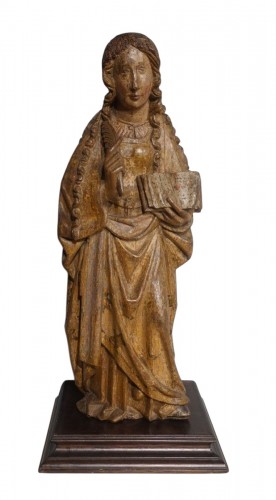
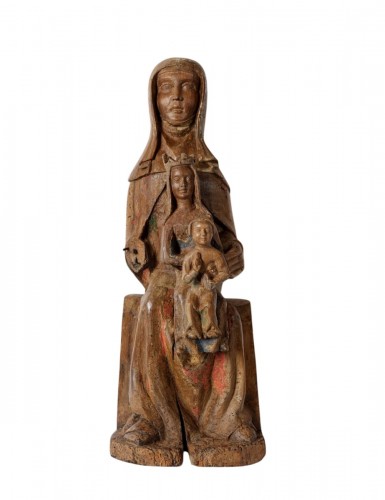
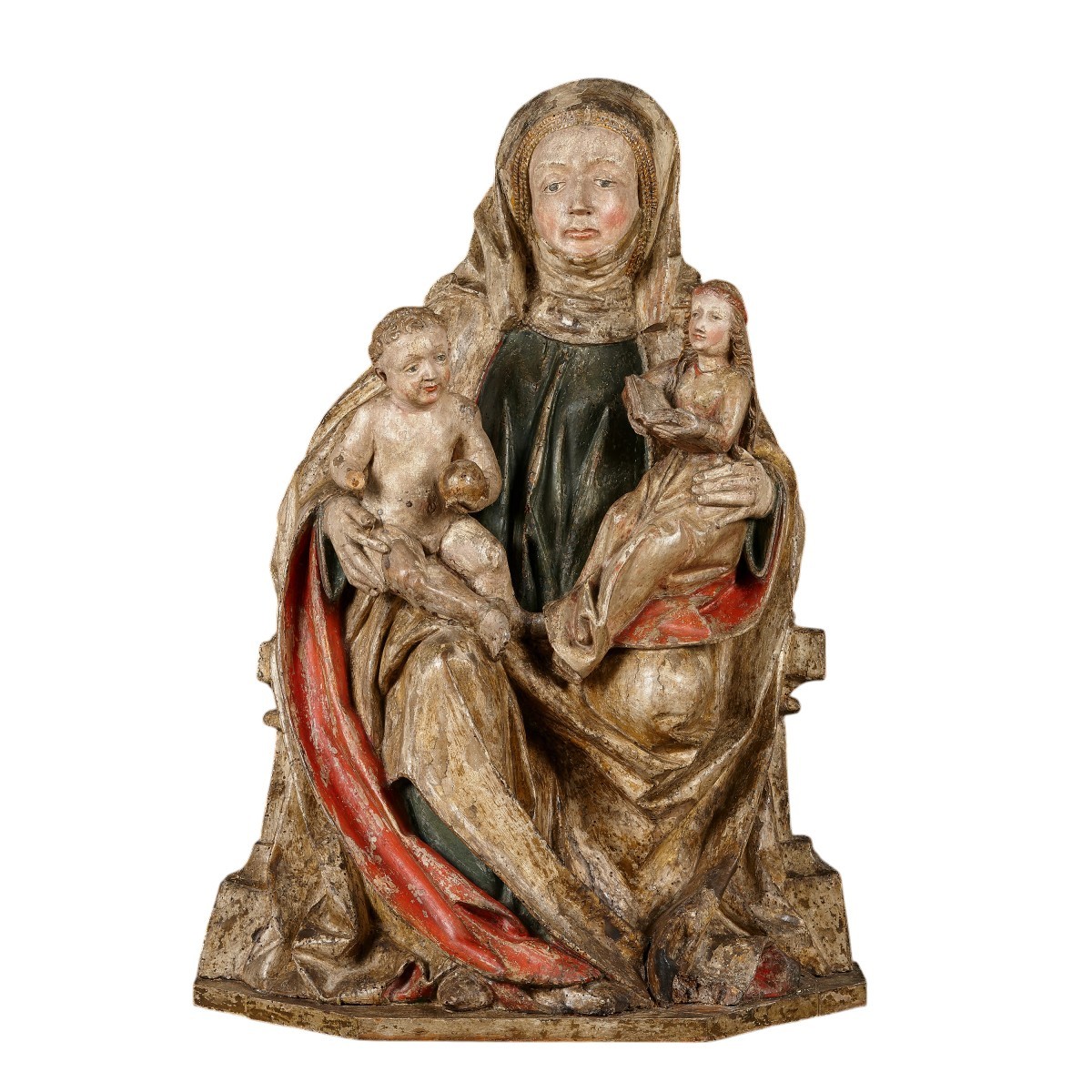
Carved wooden groups depicting the Virgin and Child with Saint Anne, the mother of the Virgin Mary, were very popular in Europe in the late Medieval period, particularly in southern Germany, where they took the name of ‘Anna Selbdritt’. Seated on a throne bench, Saint Anne holds the Virgin Mary and the Christ Child on her lap. She wears a white cap and a veil that runs underneath her chin. Over her dark green dress, Saint Anne wears a heavy gold cloak lined in red, which is draped over her shoulders and across her knees in animated drapery. On her right knee sits ...
... the nude Christ Child holding an orb, whom she lovingly supports with her right hand in maternal affection. With her left hand she hold the Virgin Mary, depicted in a gold dress and holding a book.
Micheal Rief places this fine group in Bavaria. The pointed shoe and the typical organisation of the drapery support a date of around 1490. He points out that Anna’s face-framing headscarf is rather unusual, since this specific type of clothing, known in German as a Kruseler, was long out of fashion by around 1490. The Kruseler, with its typical pleated rim can be traced back to around 1280. It was in high fashion from about the middle of the 14th century until after the first quarter of the 15th century. Occasionally – as in the present case – this headdress has been documented in the late 15th century. Notable too, is that the Christ Child has several nails in this body, which indicate a later attachment, possibly of a piece of cloth, in order to prudishly and modestly cover the nakedness of the Infant Jesus.
The iconography of the so-called Trinitarian Saint Anne was particularly widespread in Germanic countries and the Low Countries during the 15th and 16th centuries. This Earthly Trinity associated the mother of the Virgin with her Son in a concordance parallel to the Holy Trinity, formed by the Father, the Son and the Holy Ghost. It curiously depicts Mary in a reduced format, facing the Christ Child on Saint Anne’s lap. This representation gradually disappeared after the Council of Trent. This fine limewood group is carved in three-quarters round, flattened on the back and heavily hollowed out. The original polychrome painting and gilding are largely preserved. This is artistically outstanding and remarkably well preserved group of museum quality is testament to the workmanship of the celebrated late-medieval woodcarvers from Bavaria.
Retrouver le mobilier ou les objets d''art similaires à « Sainte Anne Tinité » présenté par Floris van Wanroij Fine Art, antiquaire à Dommelen dans la catégorie Sculpture en Bois Moyen Âge, Sculpture.